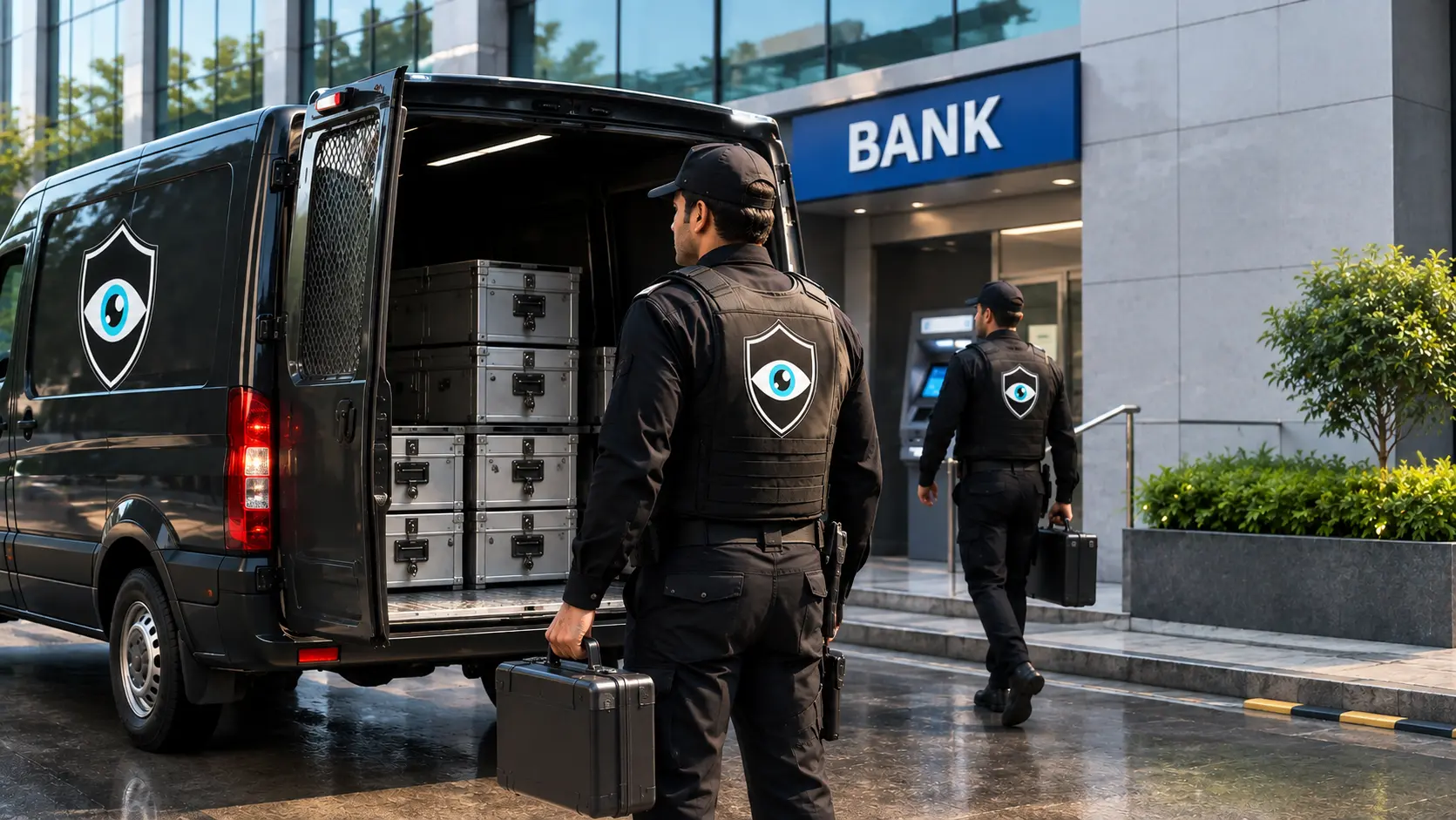
ATM replenishment involves far more than transporting cash from a bank branch to an ATM. Every movement combines valuable assets, sensitive information, personnel, vehicles and operational schedules. A security lapse during collection, transit or cash loading can create financial, operational and reputational consequences for a bank.
For banks and financial institutions, selecting the right security escort partner therefore requires careful evaluation. The focus should extend beyond the number of guards provided. Banks should assess training, route discipline, verification procedures, communication systems, emergency response, compliance and the escort partner’s ability to follow a documented security process.
The Reserve Bank of India has issued several security and cash-management measures covering ATM operations and cash movement. RBI guidance has also emphasised the importance of robust mechanisms for timely ATM replenishment and security controls around cash handling. (Reserve Bank of India)
For a bank evaluating an ATM replenishment security partner, the following factors deserve close attention.
1. Experience in Banking and Cash Movement Security
ATM cash movement requires specialised handling. A security agency experienced primarily in residential, commercial or industrial guarding may not automatically have the operational expertise required for cash escort assignments.
Banks should look for a partner with experience in:
- ATM replenishment movements
- Bank branch and cash-office security
- Cash-in-transit escort
- High-value asset movement
- Route-based security operations
- Coordination with local authorities
- Emergency response procedures
A capable escort team should understand the difference between routine guarding and protecting a planned cash movement.
2. Properly Verified and Trained Security Personnel
Personnel involved in ATM replenishment operate in a high-responsibility environment. Background verification, identity verification and appropriate training should form part of the selection process.
RBI’s cash-management guidance includes requirements relating to trained personnel and meticulous character and antecedent verification for personnel associated with cash handling and movement. (Press Information Bureau)
Banks should ask potential security partners:
- Are guards background verified?
- What training do personnel receive before deployment?
- Are officers trained in emergency procedures?
- How are replacements handled?
- Is refresher training conducted?
- Are deployment records maintained?
A professional security provider should be able to demonstrate a documented process rather than simply provide verbal assurances.
3. Route Discipline and Movement Planning
Predictability can create risk during cash movement. A security escort partner should therefore have a defined approach to route planning, movement coordination and checkpoints.
Route planning should consider:
- Traffic conditions
- Sensitive locations
- Known risk areas
- Alternative routes
- Communication checkpoints
- Expected arrival times
- Emergency diversion procedures
Royal Security Services highlights route discipline, checkpoint confirmation and coordination with the local police station as part of its bank and cash escort services. (royalsecurity365.com)
A good escort partner should also avoid creating unnecessary patterns that could make regular movements predictable.
4. Strong Communication and Real-Time Coordination
Security during ATM replenishment does not end once the vehicle leaves the bank. Continuous communication between the escort personnel, operations team and relevant bank representatives can provide greater visibility throughout the movement.
Banks should evaluate whether the security provider has:
- Defined communication protocols
- Check-in and checkpoint procedures
- Escalation contacts
- Emergency communication arrangements
- Movement confirmation processes
- Incident reporting procedures
Clear communication becomes particularly important when an unexpected delay, route obstruction, vehicle problem or security concern occurs.
5. Emergency Response Capability
A security partner should have a documented response plan for situations such as attempted interception, vehicle breakdown, accident, suspicious activity or other emergencies.
The bank should understand:
- Who receives the first alert?
- Who has authority to make operational decisions?
- How is the bank informed?
- How is local assistance coordinated?
- How is the incident documented?
- What happens after the immediate threat is controlled?
The objective should not simply be to react to an incident. The escort partner should have procedures designed to reduce uncertainty during an incident.
6. Compliance With Applicable Security Requirements
Banks should evaluate a security provider’s compliance credentials before entering into an engagement. Depending on the nature and location of operations, applicable regulatory and statutory requirements can include licensing, personnel verification, training, documentation and prescribed operational standards.
RBI’s guidance on ATM security has included measures such as digital One Time Combination locks and electronic surveillance, while cash-management standards address infrastructure, personnel and secure cash movement. (Reserve Bank of India)
Banks should maintain a compliance checklist and verify supporting documentation rather than relying solely on claims made during vendor discussions.
7. Documentation and Accountability
Every ATM replenishment movement should have a clear audit trail.
A professional escort partner should be capable of maintaining appropriate records covering:
- Personnel deployed
- Vehicle and movement details
- Checkpoints
- Arrival and departure confirmations
- Exceptions or delays
- Security incidents
- Supervisor checks
- Handover information
Strong documentation helps banks investigate exceptions, measure vendor performance and maintain operational accountability.
8. Local Knowledge and Police Coordination
Local knowledge can add another layer of protection. An escort partner familiar with the operating geography can better understand traffic patterns, sensitive areas, access challenges and emergency resources.
Royal Security Services states that its bank and cash escort operations include coordination with the local police station before movement and checkpoint confirmation during the journey. (royalsecurity365.com)
For banks operating across multiple locations, the ability to maintain consistent standards while adapting to local conditions can be particularly valuable.
9. Scalability and Operational Reliability
Banks rarely need security support for a single ATM movement. Requirements can expand across branches, ATM networks and multiple geographical areas.
A suitable partner should demonstrate the ability to scale without compromising:
- Personnel quality
- Verification standards
- Training
- Communication
- Supervision
- Reporting
- Response capability
Operational reliability should also be assessed during vendor evaluation. Ask about backup personnel, supervisory structures and contingency arrangements.
Choosing Security Beyond the Escort
ATM replenishment security should be treated as a complete operational process rather than simply placing a guard beside a cash vehicle.
The right escort partner combines trained personnel, disciplined movement procedures, strong communication, compliance, documentation and emergency preparedness. Banks should evaluate each component before awarding a contract and periodically review performance after deployment.
Royal Security Services provides bank and cash escort services with a focus on route discipline, checkpoint confirmation, security personnel deployment and local police coordination. Its banking security offering also covers bank branches, ATM lobbies, cash offices and other banking premises. (royalsecurity365.com)
For banks, the right question should not be, “How many security guards can you provide?” The better question is, “How effectively can you protect every stage of our ATM replenishment movement?”
A security partner that can answer that question with trained people, defined processes and measurable accountability can become an important part of a bank’s broader cash-security framework.