Choosing between armed and unarmed security personnel is rarely a simple checkbox decision. Site owners, facility managers, and business heads often assume more firepower automatically means more protection, but a mismatched deployment can create legal exposure, inflate costs, and even raise risk instead of lowering it. Royal Security Services has spent years fielding trained guards across residential, commercial, and industrial sites, and the pattern is consistent: the right choice depends on threat level, property type, and regulatory compliance, not on instinct alone.
Understanding the Core Difference
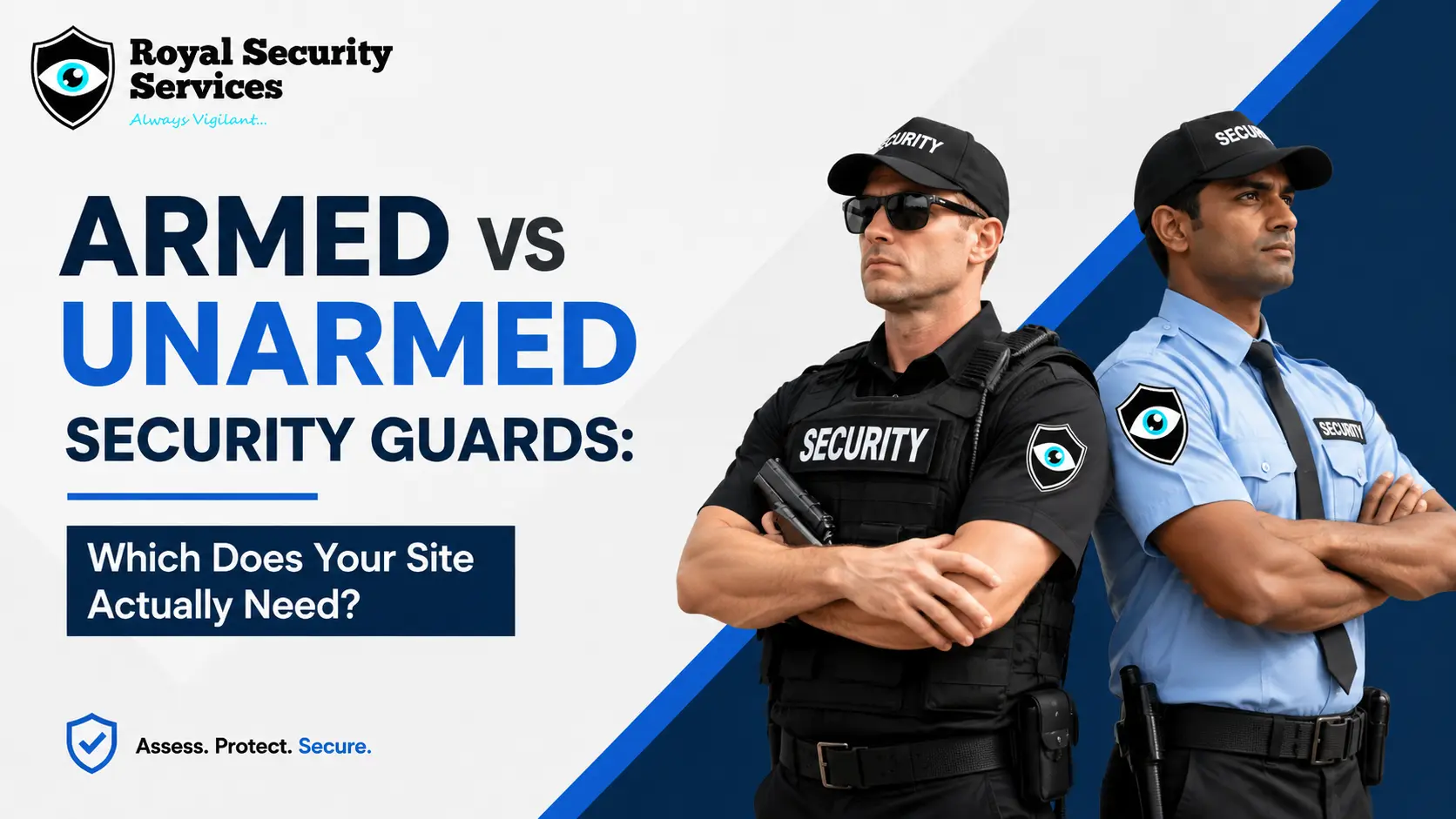
An unarmed guard is trained in surveillance, access control, patrolling, conflict de-escalation, and emergency response. An armed guard carries every one of those responsibilities plus a licensed firearm, along with additional training in weapon handling, use-of-force protocols, and high-threat scenario management.
What Unarmed Guards Bring to a Site
Unarmed personnel remain the standard choice for the vast majority of properties in India, including apartment complexes, retail outlets, warehouses, schools, and corporate offices. Their presence deters casual theft, manages visitor flow, and provides a visible, approachable layer of security. Because firearm licensing carries strict conditions, deploying unarmed guards also keeps operational and legal overhead lower.
What Armed Guards Bring to a Site
Armed personnel are reserved for locations carrying elevated risk: banks, jewellery showrooms, cash-in-transit operations, industrial plants storing hazardous material, and VIP residences. A licensed firearm changes the deterrence calculus for an intruder and gives the guard a tool of last resort during an active threat. Armed deployment, however, is not something a security agency can offer freely; it depends on the client’s risk profile, the agency’s arms licensing, and each guard’s individual firearm qualification.
Regulatory Reality in India
Private security in India operates under the Private Security Agencies (Regulation) Act, commonly known as PSARA, along with state-level rules and, where firearms are involved, the Arms Act. Agencies must hold a valid PSARA license to operate at all, and arming a guard requires a separate firearm license tied to that individual, not just the agency. A reputable provider will never place an armed guard on a site without verifying both the agency’s authorization and the guard’s personal firearm proficiency and clearance. Any vendor offering armed guards without walking a client through this documentation should raise an immediate red flag.
Factors That Should Drive the Decision
Nature of Assets on Site
Cash reserves, precious metals, pharmaceuticals, or sensitive data centres carry a different risk profile than a residential lobby or a retail showroom. Higher-value or higher-liability assets tend to justify armed coverage.
Location and Crime History
A site in an isolated industrial belt or an area with a documented history of armed robbery or trespassing warrants a different posture than a gated urban complex with strong perimeter lighting and CCTV coverage.
Footfall and Public Interaction
Sites with heavy public footfall, such as malls, hospitals, or schools, generally favour unarmed guards trained in de-escalation and crowd management. Introducing firearms into a high-footfall, high-emotion environment can raise liability rather than reduce it.
Insurance and Liability Requirements
Some insurers and corporate clients mandate a specific security posture as a condition of coverage. Facility managers should confirm whether their policy or client contracts specify armed or unarmed requirements before finalising a vendor.
Building the Right Security Posture
A professional security partner does not sell a one-size answer. Royal Security Services approaches every site with a risk assessment first: reviewing asset value, footfall patterns, past incidents, and access points before recommending a deployment model. In many cases, the strongest posture blends both, an unarmed team handling access control and patrolling, supported by an armed guard stationed at a single high-risk point such as a cash counter or a server room.
Why Expertise and Compliance Matter
EEAT, the framework Google uses to evaluate content quality, stands for Experience, Expertise, Authoritativeness, and Trustworthiness. Applied to security decisions, it translates directly: work with a provider that has real field experience across varied site types, employs trained and background-verified personnel, holds valid PSARA and arms licensing, and operates transparently on documentation. A vendor that cannot produce licensing paperwork on request is not a vendor worth trusting with either armed or unarmed deployment.
Final Word
Neither armed nor unarmed security is inherently superior. Effective protection comes from matching the deployment to actual risk, verified licensing, and trained personnel, not from defaulting to whichever option sounds more imposing. Site owners evaluating their current setup should request a proper risk assessment before locking in a decision either way.
Royal Security Services conducts on-site risk assessments across residential, commercial, and industrial properties to help clients determine the right mix of armed and unarmed personnel, backed by full PSARA compliance. Visit royalsecurity365.in to schedule a consultation.